Custom website development
Websites for businesses that have outgrown templates: fast, custom-designed, multilingual where you need it, easy for your team to edit and built on a solid search foundation. After launch, the code and every login are yours.
We start a website project with one question: what does the site need to do for your business? Bring in enquiries, present a product range, win over customers in another country, or cut down the calls that all ask the same thing. The answer shapes the structure, the copy, the forms and what a visitor sees first. A template can’t make those decisions for you, so every site we build starts from your goals rather than a theme.
We build without off-the-shelf themes or a pile of plugins. The result is a site that loads quickly on a phone, says clearly what you do and that your team can keep up to date. We adapt to any tech stack your project needs, and we judge every choice by how easy the site will be to look after in one or three years’ time.
Who it’s for
- Manufacturers and service companies with a wide range of products or services that need to be organised so customers find the right one.
- Businesses selling into other EU markets that need several languages and content written for each country’s customers.
- Companies whose current site is slow or dated, hard to edit, or no longer reflects what the business does today.
- Teams that rely on the website for leads, where forms have to work every time and search engines have to find the pages.
If all you need is a single page for a campaign, a lighter solution may be enough, and we will tell you so in the first call.
What we build
Multilingual sites for foreign markets
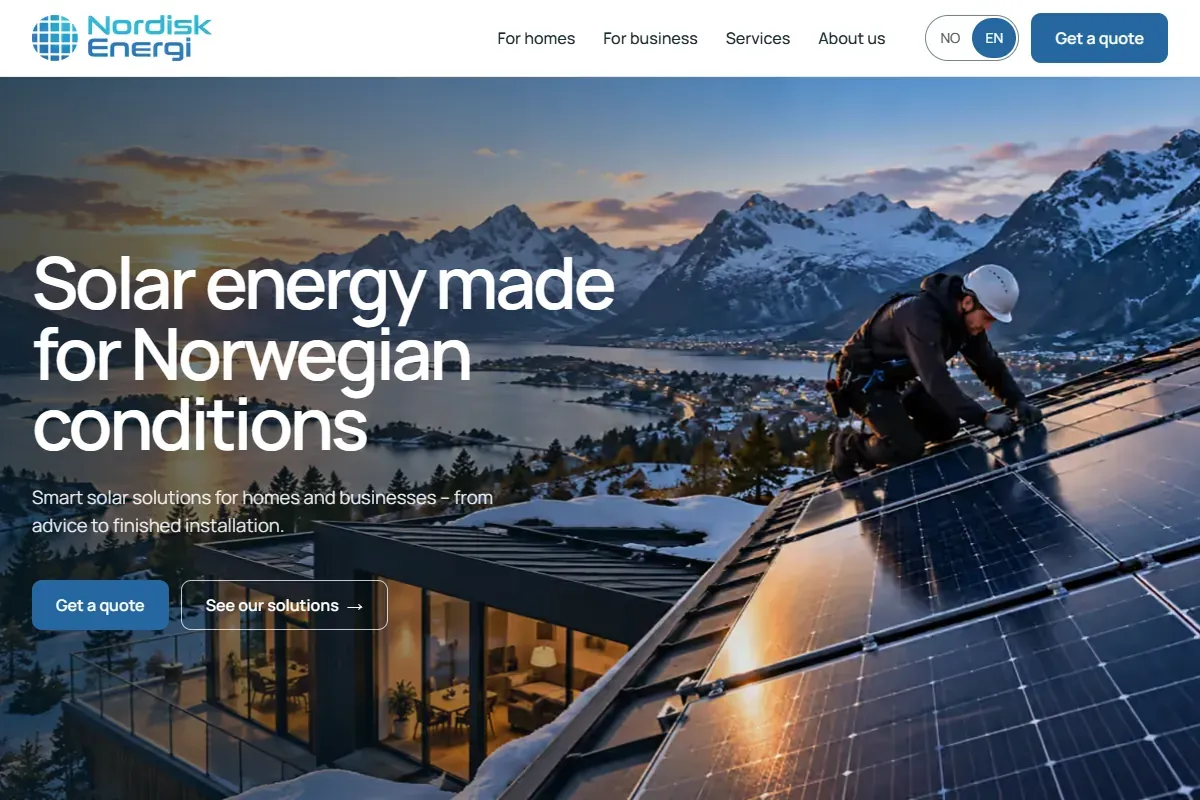
A multilingual site is more than the same text run through a translator. Each language gets its own URLs, correct hreflang tags, a language switcher that lands on the matching page, and content adapted to the people reading it. For example, we built the Nordisk Energiwebsite for the Norwegian market: separate journeys for homes and businesses, a quote request, and two languages, Norwegian and English.
Product catalogues and calculators
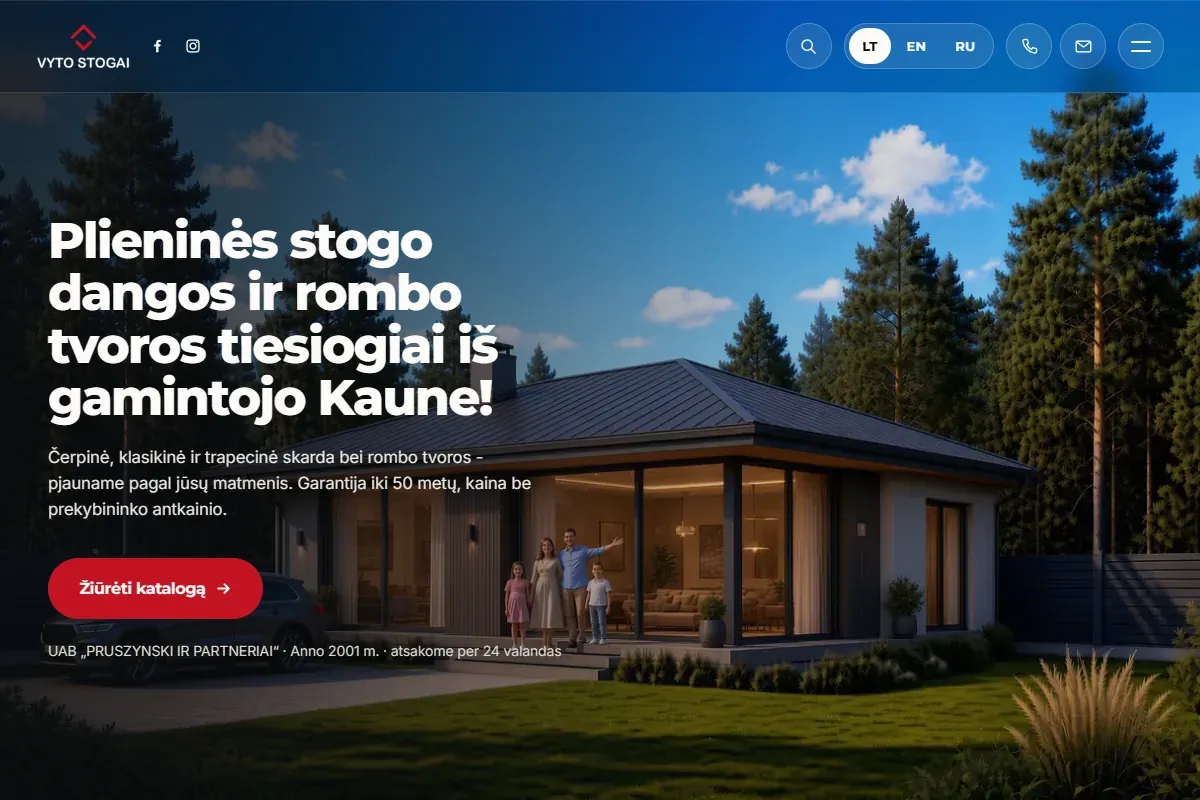
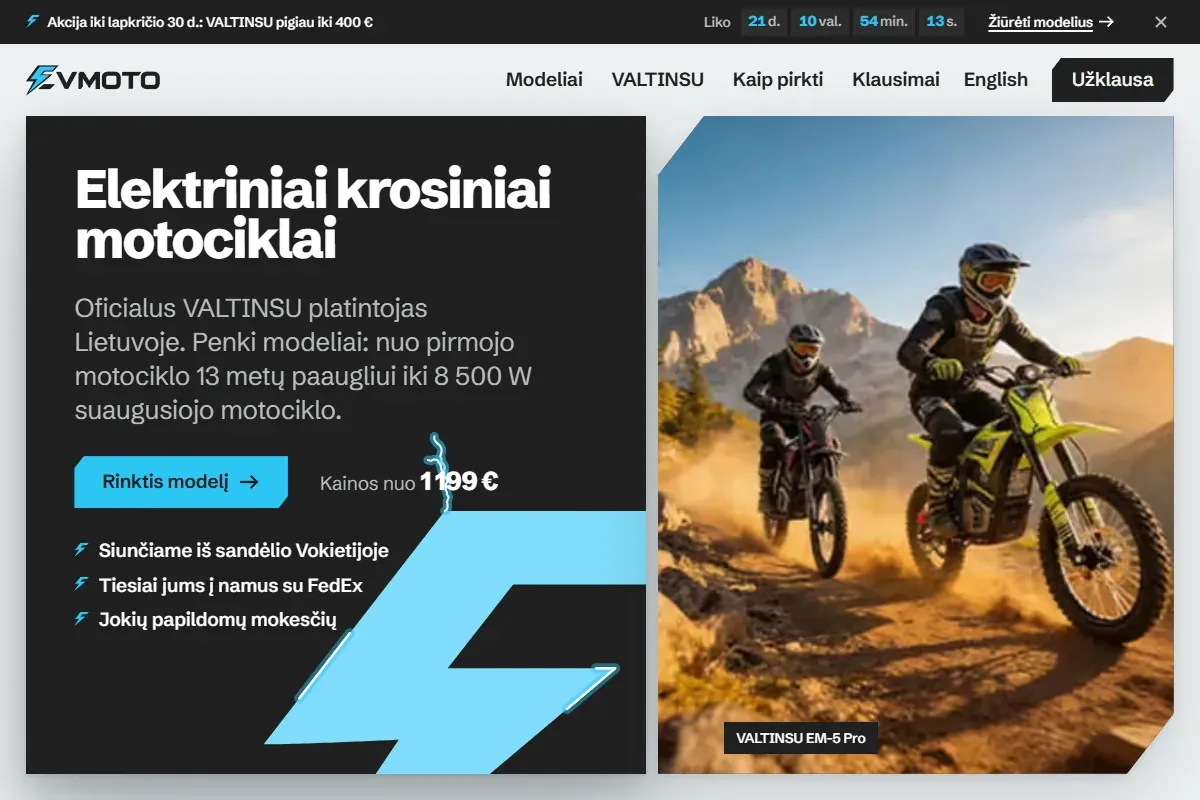
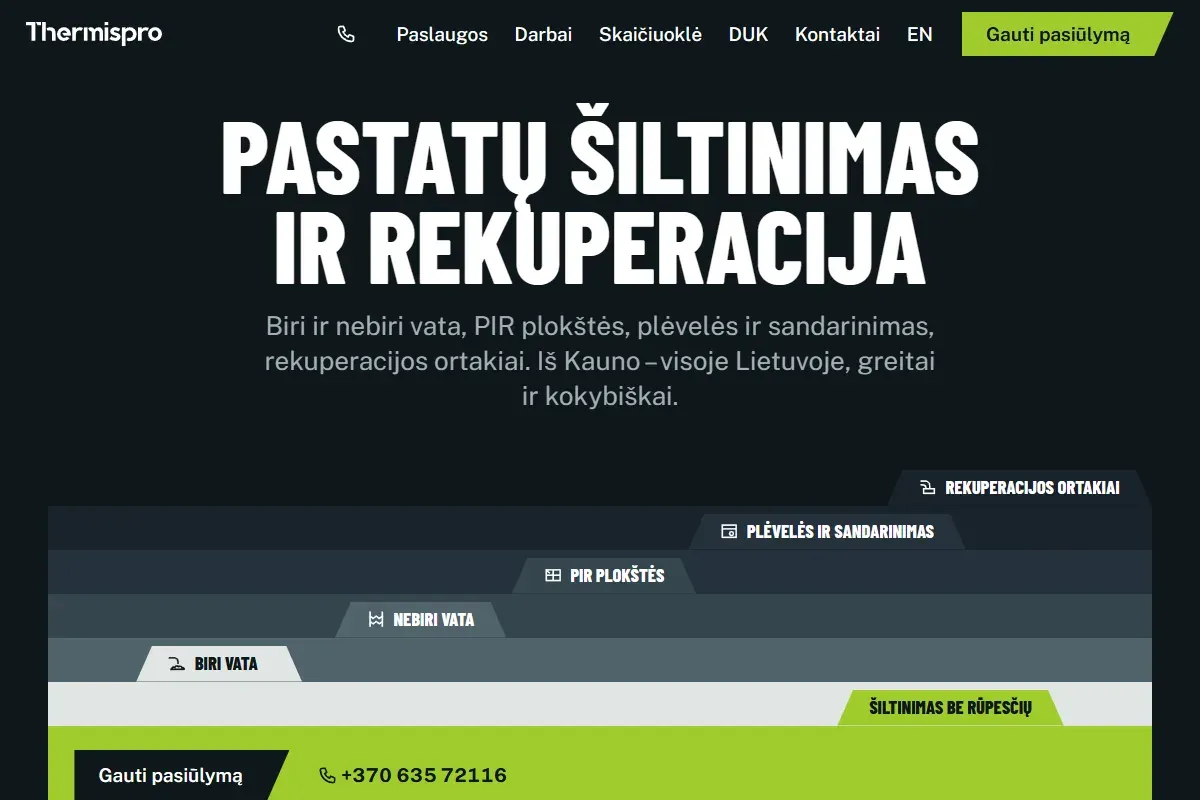
When the range is large, what matters is that a customer finds the right product quickly and can ask for a price. Vyto stogai, a steel roofing and fence manufacturer, has a product catalogue, a gallery and an inquiry form in three languages: Lithuanian, English and Russian. On EVMOTO, visitors compare five electric off-road motorcycle models and pick one by age and height, and theThermispro site includes a heat-loss calculator. Tools like these help a customer decide and arrive with a specific request.
Structure and copy
A good website starts with a clear structure: which pages you need, in what order, and what a visitor must grasp in the first few seconds. We map out the page tree with you and plan the content of each page. We help you write or tighten the copy so it is specific, free of filler and answers the questions customers usually ask on the phone. If suitable images or illustrations are missing, we can create them with AI when needed, so the site doesn’t wait for content.
Forms and enquiries
If the site is there to bring in customers, the enquiry form is its most important part. We keep forms short, with clear fields and error messages, protect them from spam and route every enquiry to where you will actually see it: your inbox, a CRM or a spreadsheet. Analytics runs only after a visitor consents, and we measure how many enquiries arrive and from which pages without collecting personal data.
Content management
We set up a content management system shaped around your content: products, services, a project gallery, news or articles. Fields are structured so that changing a text or a photo never breaks the layout, and a new page looks like the rest of the site from the moment it is published. If your content rarely changes, you may not need a CMS at all; we settle that during scoping.
Performance by default
We don’t fix speed after launch; we plan for it from day one. Images are served in modern formats at the right size, JavaScript loads only where it is genuinely needed, and every font and third-party script is weighed against what it costs the page. Before launch we check Core Web Vitals on mobile, because that is where most of your visitors will judge you.
SEO and GEO foundations
Every page gets a unique title and description, a single clear H1, a canonical URL, structured data and a place in the sitemap. We plan the site structure and internal links around what your customers actually search for. We also make sure the content is easy for AI search tools to read and cite, which matters now that many people ask an AI assistant before they open a search results page.
Accessibility
We build with accessibility in mind: we check colour contrast, use a correct heading hierarchy, describe images, make forms and menus work with a keyboard and keep tap targets large enough on a phone. If your sector has specific accessibility requirements, we add them to the scope and agree on them separately.
Handover and ownership
At launch we hand over all the code, the domain, hosting and account logins, and short documentation. We recommend keeping the domain and accounts in your company’s name, so you are never locked in to a single supplier. If you like, we keep looking after the site on acare plan; if not, any other team can pick it up.
How we work
- Discovery. A conversation about your business, customers and goals. We review your current site, if you have one, and the sites of your competitors, so we know where we are starting from.
- Scope and estimate. We send a page list, features, languages, integrations, an estimate and a timeline. Nothing is built until you approve it.
- Design. We design the key pages for mobile and desktop, then discuss and refine them until you are confident in the direction.
- Build and test. We develop the site, load the content and test it across browsers and devices: speed, forms, accessibility and SEO tags.
- Launch and support. We go live, set up redirects from the old URLs, hand over the logins and show you how to edit content. After that we can keep maintaining and improving the site.
One accountable lead runs the project from the first call to launch, so you never have to explain things twice. We reply within one business day.
A website, or something more?
Sometimes the first call shows that a website is only part of the answer. If you want to sell online, seee-commerce development. If customers need to log in, place orders or see their own data, you are looking at a web platform. And if the site should answer common questions or route enquiries on its own, have a look at our AI automation work.